Partial project on the editorial processing of the I.G. Farben trial
As part of the “Digital Nuremberg Military Tribunals” (DigiNMT), a collaborative project between by the Bayerischen Akademie der Wissenschaften (BAdW), the Friedrich-Alexander-Universität Erlangen-Nürnberg (FAU) and the General Directorate of the Bavarian State Archives, the Finkelstein Foundation is funding the editorial processing of the I.G. Farben Trial.
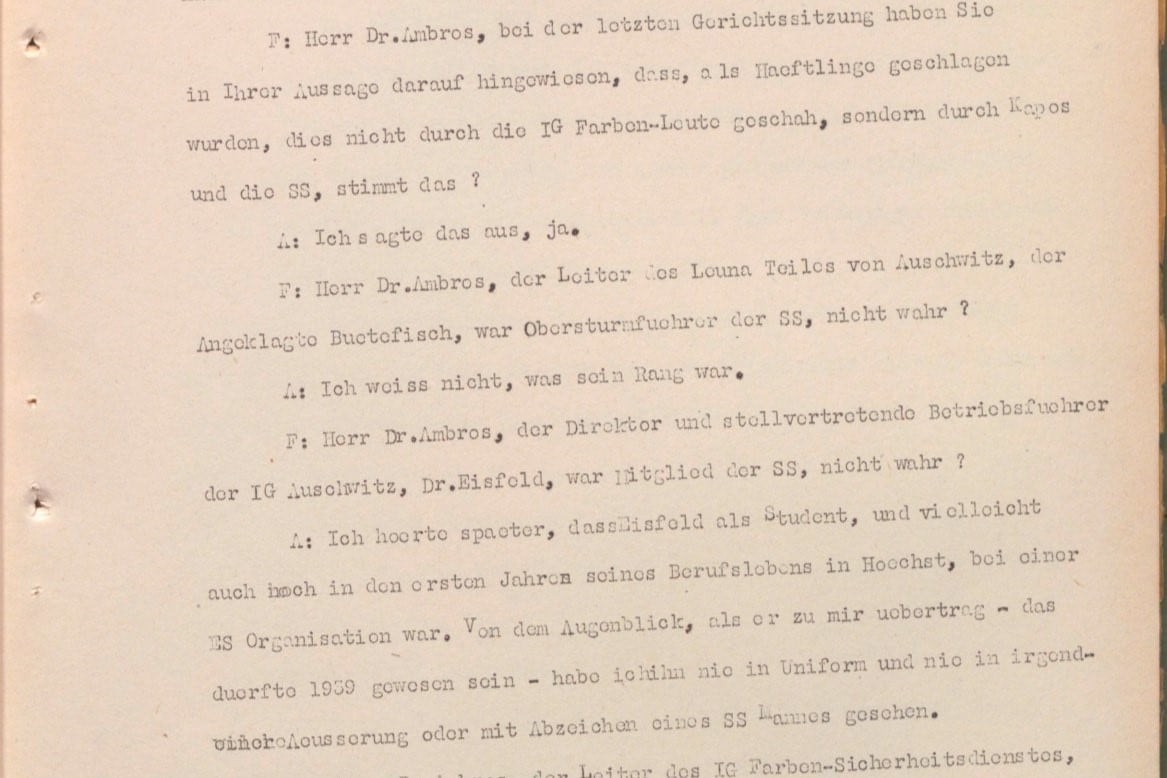
Fig.: Extract from the word-for-word transcript of the main hearing in the IG Farben trial.
Over a period of two years, this funding will lay the groundwork for the academic study scholarly examination and editorial publication of one of the most significant Nuremberg trials.
The I.G. Farben trial was the largest of the Nuremberg industrial trials trials of German industrial companies. The relevant file collection (/related files) at the Nuremberg State Archives comprise(s) 1,268 archival units containing around 111,330 pages; in addition, there are extensive defence documents and transcripts of witness examinations. These materials constitute documents are a key source for historical and legal research, but until now they have been accessible primarily only on site and in paper form.
DigiNMT aims to make the files of the Nuremberg follow-up trials available digitally, to systematically catalogue them and to add further contextual information. This includes the preparation ofcompiling historical background material, such as the biographies of those involved, and the analysis of analyzing legal considerations and arguments, as well as the development of establishing the technical infrastructure for sustainable digital provision access and further processing.
This funded partial project will enable a more in-depth understanding of the I.G. Farben trial as a central component part of the Nuremberg follow-up trials. This will not only finally give the academic community and the (general) public access to the this body of these trial documents but will also contribute to research into on the role of industrial enterprises under National Socialism and the historical development of modern international criminal law.