Testimonials from ASF Volunteers
The organization Action Reconciliation Service for Peace (Aktion Sühnezeichen Friedensdienste, ASF) offers a wide range of opportunities to spend a year volunteering abroad while contributing to education and transnational remembrance. Since 2025, the Hans and Berthold Finkelstein Foundation has been funding six ASF project sites annually. Some volunteers have shared their experiences with us after their volunteer year.
Rona reflects on her ASF year in Mechelen (Belgium)
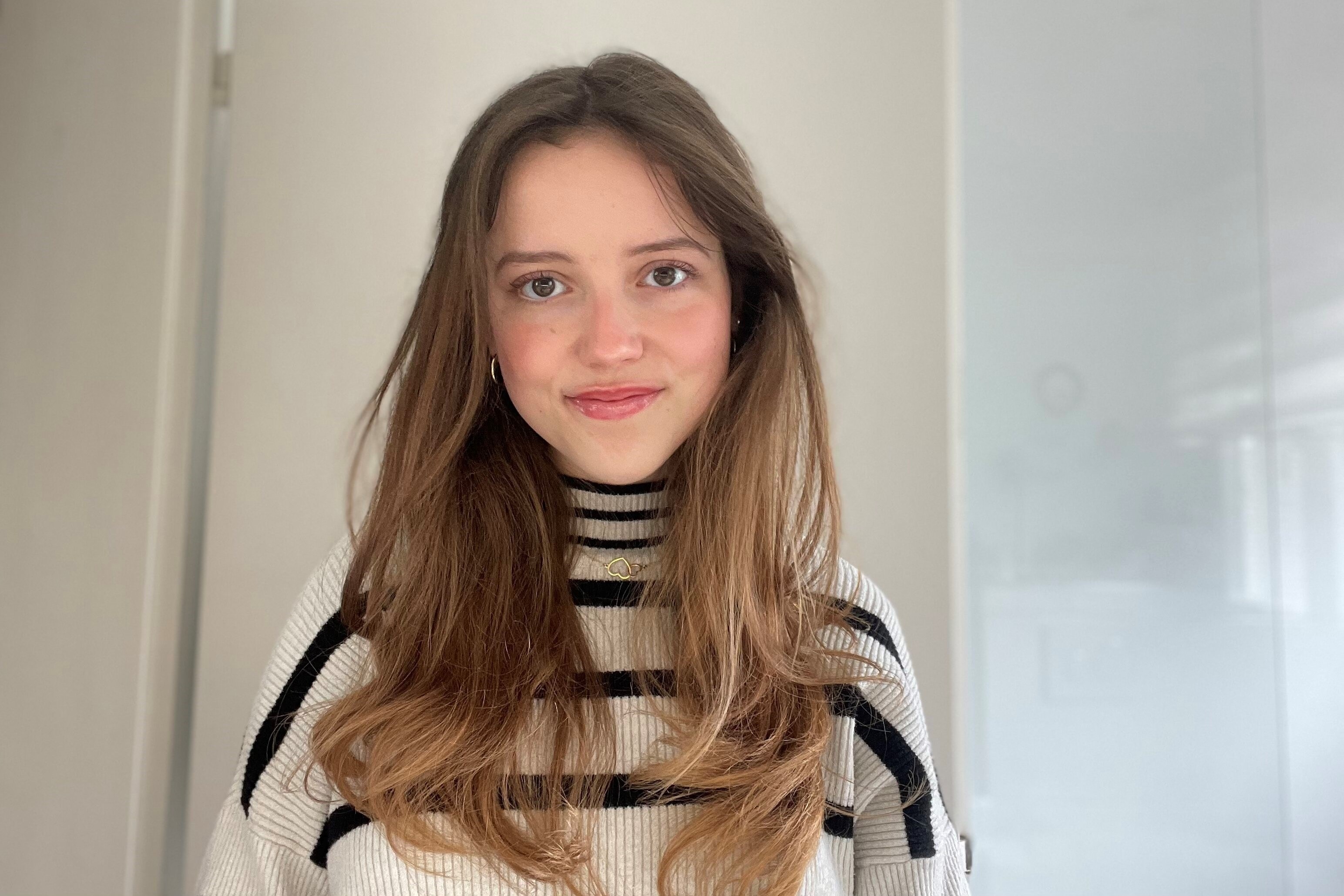
Rona from Hemer, Germany, spent a year volunteering with ASF at the Kazerne Dossin Memorial in Mechelen.
I work at the Kazerne Dossin, where the museum displays a wall spanning four floors with portraits of the 25,843 victims who were deported from there during World War II - primarily people of the Jewish faith, but also approximately 350 Sinti and Roma. The old barracks served as a transit camp because Mechelen is located between the two major cities of Antwerp and Brussels, both of which had large Jewish communities. The transit camp was also strategically located, directly adjacent to the railroad tracks, from which the 28 transports departed for Auschwitz between 1942 and 1944. Only about 5% of the people returned from Auschwitz; the vast majority were murdered in the gas chambers immediately upon arrival. Even though no one was killed in the barracks and there was little physical violence there, I am aware of the significance of my workplace as the “antechamber to Auschwitz.”
The museum has taken on the mission of restoring the dignity and individuality of the victims. Their humanity has been stripped away, for example, by reducing them to mere numbers during their registration at the barracks. A wall that stretches across four floors in the museum illustrates the scale of the crime and restores some of the identity that the victims were forced to surrender before their deportation. A relatively new project at the museum also serves to commemorate the victims in this way: not only by restoring their faces, but also their stories. As part of the “Elke naam telt” (“Every Name Matters”) initiative, museum visitors or groups can register to record the name of one of the victims in one of the museum’s sound studios. The algorithm assigns them a story that is biographically connected to them in some way, for example by either sharing a name, date of birth, or age. This “commonality” makes recording a name a very personal experience.
One of the highlights this year was the guided tour I had the opportunity to lead for a school class from Berlin at the end of March. I wrote and prepared the tour myself and rehearsed it with another German-speaking guide. What I like about my work is that it’s very varied, since I work in different departments of the museum. I’m almost more of a colleague than a volunteer.
Lucie reflects on her ASF year in Osnabrück
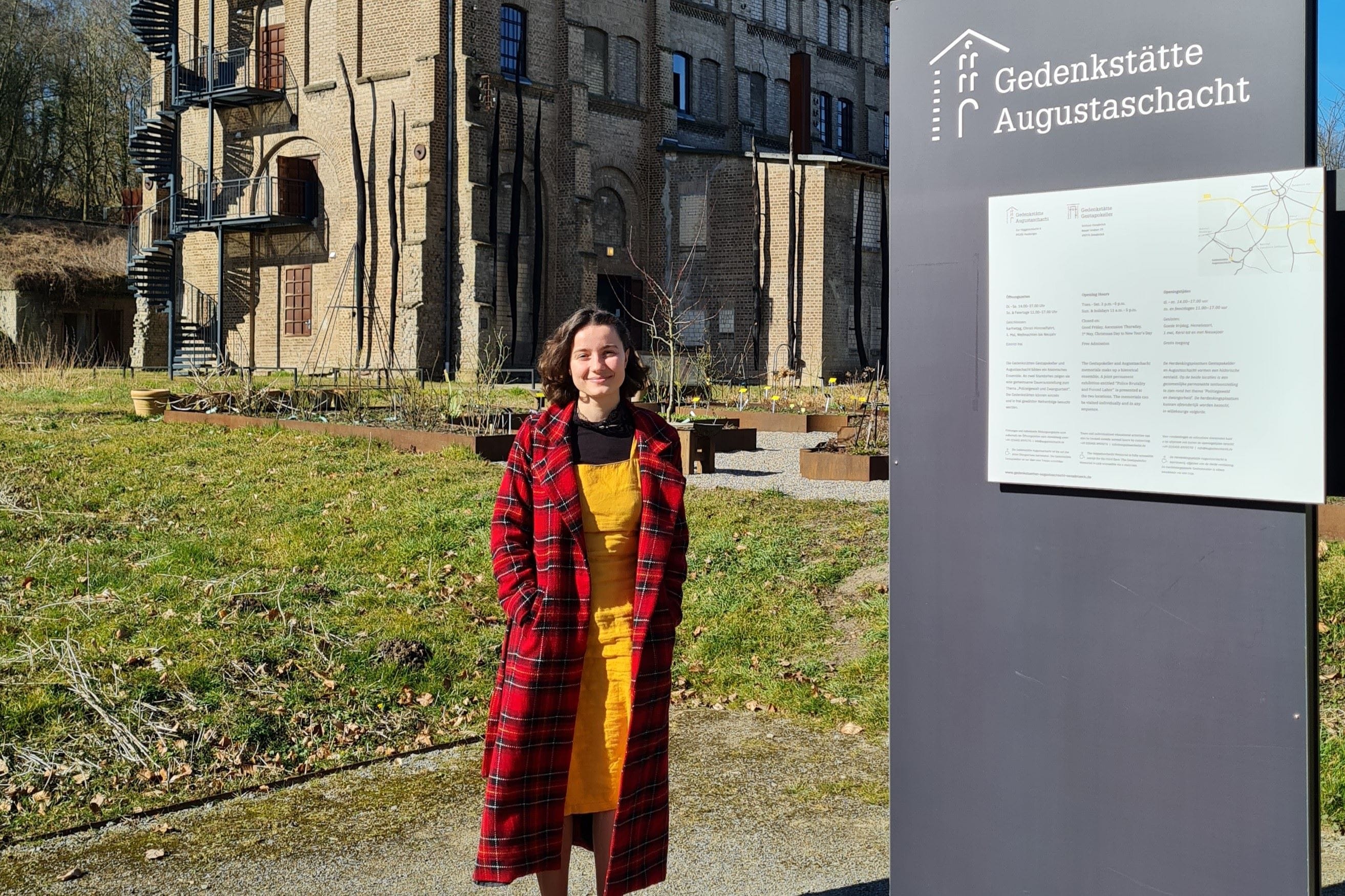
Lucie from Divonne-les-Bains, France, spent a year volunteering with ASF at the Augustaschacht Memorial in Osnabrück.
Augustaschacht is a small memorial site, and at first I was worried that it might be less interesting than a larger one. But now I see its size as an opportunity, because it allows me to explore all kinds of tasks within the memorial site. Since it’s small, there aren’t any clearly defined departments, and I can help out everywhere. Right now, I’m mainly working with digital archives. Since 2000, the memorial has been recording videos with survivors and eyewitnesses. Many of these were created as part of a program called the "Begegnungsprojekt" (“Encounter Project”). Students from Osnabrück collaborated with high school students from Belarus or Ukraine to jointly interview eyewitnesses from the respective Eastern European country. In addition, I have the opportunity to lead guided tours of the memorial in English, and I am working on offering them in German as well, which would allow me to participate in workshops with school groups. I will also be conducting research on former French prisoners.
Augustaschacht is part of a network of memorial sites focused on forced labor. This network collaborates on joint projects, and it gives me many opportunities to travel. These trips are, of course, key moments in my volunteer service, but my work is also marked by many simple yet fulfilling moments: For example, when I see my colleague Tania using the files I’ve created, or when I find that missing piece of information everyone has been looking for. I’m happy to see the results of my work, and I like being able to contribute, in my own small way, to preserving a memory that is so painful and has only recently been restored.
Getting to know the various activities in the field of history was one of the reasons I decided to do this volunteer program - and I wasn’t wrong. Over the course of the year, I was confronted with the challenges of digital archiving. This not only fascinated me but also helped me make the decision to change my studies and begin a master’s program in Digital Humanities and Digital Archiving.
My experiences have sparked many discussions with friends, family members, and colleagues. I now understand that, when people think of fascism, many focus only on its most extreme consequences - dictatorial violence and overt terror. They don’t recognize fascism until it’s already in power.
Lena reflects on her ASF year in Paris
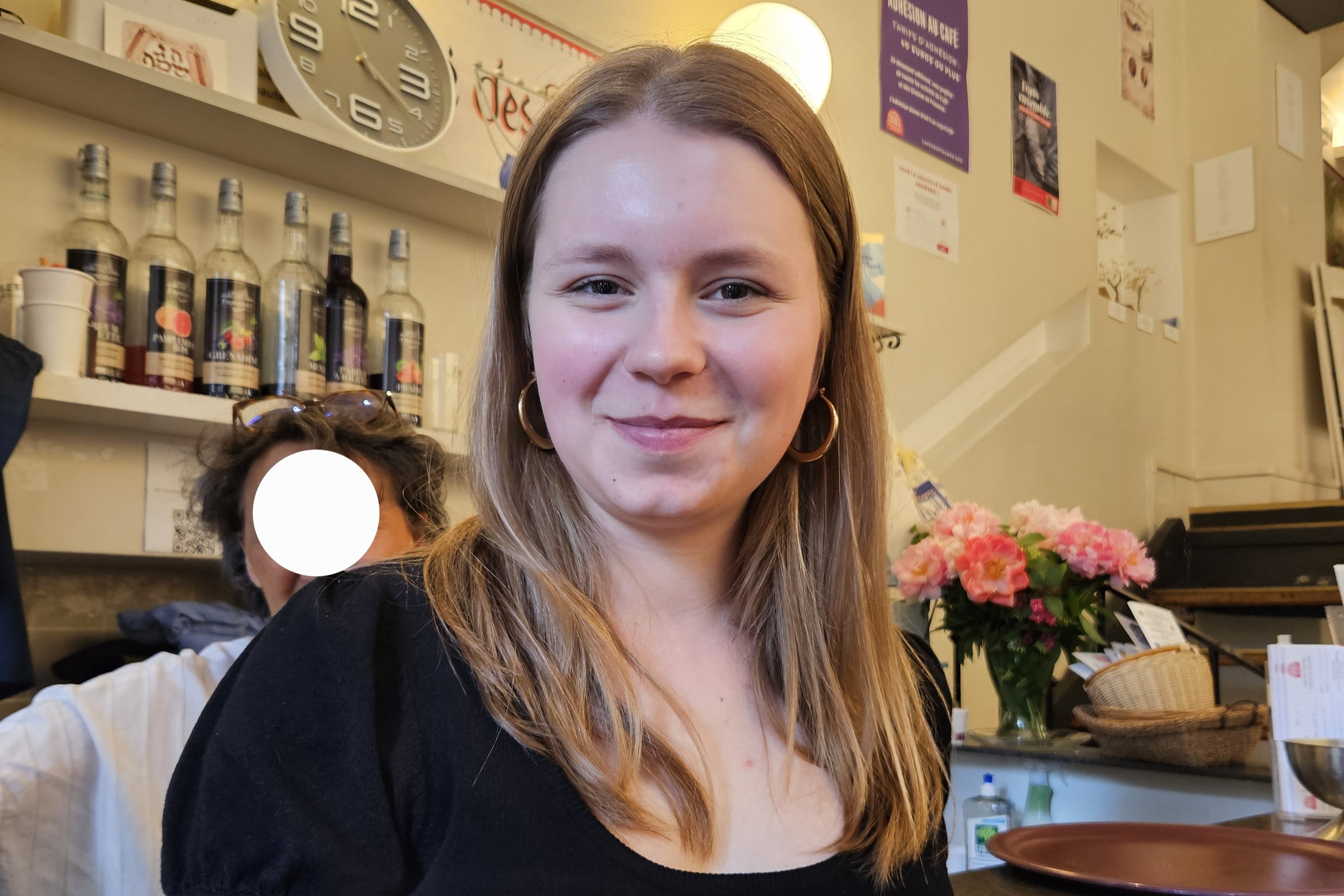
Lena from Brühl, Germany, spent a year volunteering with ASF at Café des Psaumes (as part of the Convoi 77 project) in Paris.
I am working as a volunteer on a two-part project. On the one hand, I work at the Mémorial de la Shoah, the central memorial site for the Shoah in France. The Mémorial is located in the Marais, the Jewish quarter of Paris, and serves as both a memorial and a museum, as well as a center for research and documentation. More specifically, I am involved in the Convoi 77 project there. The goal of this project is to compile the biographies of the 1,306 deportees from the last convoy, which departed from the Drancy transit camp near Paris on July 31, 1944, bound for Auschwitz. School classes, teachers, professors, and volunteers can register online. After being assigned one of the deportees, they research that person’s fate and then publish their findings in the form of a biography on the project’s website. The idea behind the project - which operates internationally, specifically in all 32 countries from which the deportees of Convoy 77 originated - is to convey the Shoah to younger generations using innovative educational methods, thereby preventing history from being forgotten. Through independent research, volunteers or school classes can piece together the lives of the deportees bit by bit, gaining a much more personal understanding of the extent of the Shoah and the human lives it claimed. As a volunteer, I have also been assigned one of the deportees, whose biography I am now researching.
In addition to my research work, I help out every Tuesday with what’s called “Permanence Photo” – which translates something like “photo hotline.” In the afternoons, eyewitnesses or people with any kind of connection to the Shoah can come to the Mémorial to drop off documents, photos, or other mementos and share their family histories. I find this incredibly moving, especially because prior to my year of volunteer work, I knew very little about, for example, the rafles - the mass arrests in France - or the fates of the enfants cachés, the hidden children. Through these eyewitness reports, I’m gaining a completely different perspective on the lives of Jews during World War II, not just in Germany.
In November, the Mémorial de la Shoah organized an event as part of the “live2tell” project, a photography and installation project by a New York-based photographer, during which approximately 60 Holocaust survivors were invited to have their portraits taken and to be interviewed. The photos, along with quotes from the interviews, will subsequently be projected onto public buildings to draw attention to the personal stories and memories of Holocaust victims. On that day, my fellow volunteer and I welcomed the guests at the Mémorial, escorted them to the photo booth and to the photographer, and helped with the organization. Even though we didn't play a major role in the whole event, it was incredibly exciting to interact with so many eyewitnesses, to see old friends recognize each other - people who had met during previous interviews at the Mémorial - and to get a sense, through brief conversations, of how significant this moment was for the Holocaust survivors.
Many thanks to the Hans and Berthold Finkelstein Foundation for funding my volunteer service.