Biographical Study on
Fritz ter Meer
A research project on the historical analysis of a key figure of I.G. Farben. This study examines the life of Fritz ter Meer, focusing particularly on his role at I.G. Farben, his responsibilities in technical and strategic decision-making processes, and his place in the history of 20th-century science and industry.
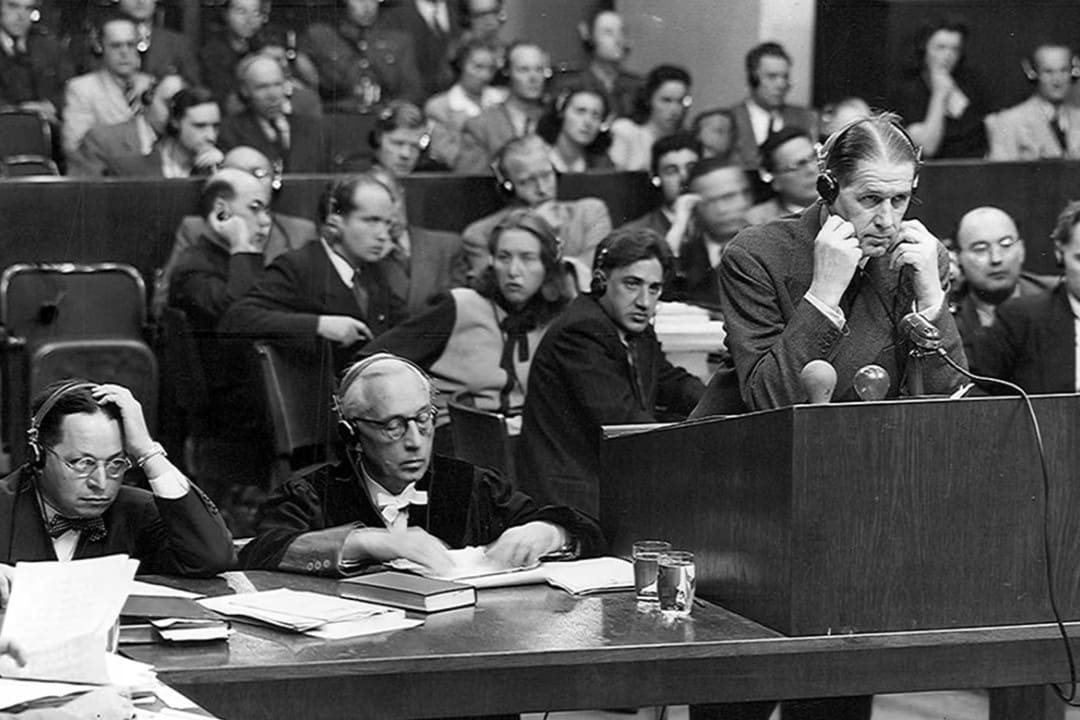
Fritz ter Meer at the Nuremberg Trials, 1947. Photo: Office of Chief of Counsel for War Crimes, Nuremberg, Germany / Bayer Archive.
The study integrates the various phases of ter Meer's life into a coherent analysis, contextualising his activities within the economic, political, and institutional structures of his era.
The study is conducted by PD Dr. Florian Schmaltz, a historian of science specializing in the history of chemistry, industrial research, and science policy. Schmaltz has extensive experience in analyzing corporate archives, international research networks, and the interdependencies between science, industry, and state policy. His disciplinary perspective enables a nuanced evaluation of historical sources and an accurate assessment of Fritz ter Meer’s professional roles and scope of action in varying historical contexts.
The aim of the study is to historically contextualize Fritz ter Meer’s professional positions and decision‑making paths and to analyze his functions and networks within I.G. Farben with precision. In doing so, it provides a foundation for better understanding structures of responsibility, continuities, and corporate historical developments in the 20th century.
For the period of National Socialism, the study examines his involvement in armament initiatives, industrial agreements, and chemical weapons projects. A central focus is his responsibility for the Auschwitz‑Monowitz plant, which was integrated into the system of forced labor and where thousands of concentration camp prisoners died as a result of the conditions.
Following the Second World War, the study addresses the I.G. Farben Trial, in which ter Meer was convicted of plunder and enslavement in 1948, and his subsequent release in 1950. It then outlines his subsequent roles in the West German economy, including his reintegration onto leading corporate boards, such as at Bayer AG, and his involvement in the Federal Republic's economic networks.
The project is financially supported by the Bayer Foundation. The former Fritz‑ter‑Meer Foundation was later renamed the Bayer Scholarship Foundation and was fully integrated into the Bayer Science & Education Foundation in 2007. Through this support, the Bayer Foundation contributes to the examination of its own institutional history.
Information about the research project can also be found here.