“Forgotten Collaborations?”
Italian Fascism and the Malaria Research of I.G. Farben. A New Perspective on the Role of I.G. Farben in German–Italian Scientific and Economic History.
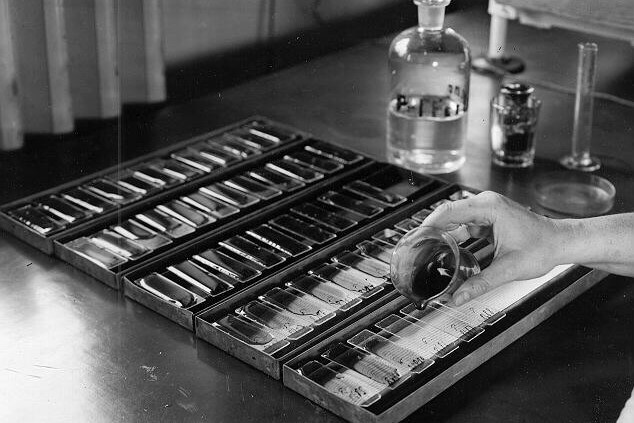
Chemotherapeutisches Labor Werk Elberfeld 1936 © Bayer AG, Bayer Archiv Leverkusen
The project at the Faculty of Economics at the University of Siegen examines I.G. Farben's malaria research from a previously unexplored German-Italian perspective. At its core is the question of whether, and to what extent, political actors and scientists in fascist Italy during the 1920s and 1930s used or further developed this research for their own purposes. By doing so, the project situates I.G. Farben’s tropical medicine research within the context of two fascist regimes and enables a reassessment of its role in German and Italian scientific history.
This shift in perspective reveals existing gaps in cultures of remembrance. The project critically interrogates established narratives, traditional perpetrator‑ and victim‑roles, and the often nationally confined attribution of responsibility for fascist crimes. The central argument here is that malaria research serves as a suitable example for discussing the economic, ethical, and political responsibilities of scientific practice.
Methodologically, the project combines historical‑hermeneutic archival research with a participatory, social‑anthropological approach. This makes it possible to illuminate structural contexts as well as individual, collective, and intergenerational dynamics within cultures of remembrance.
More informations: Forgotten collaborations? | Universität Siegen